A Brief History of Chandler Motor Cars
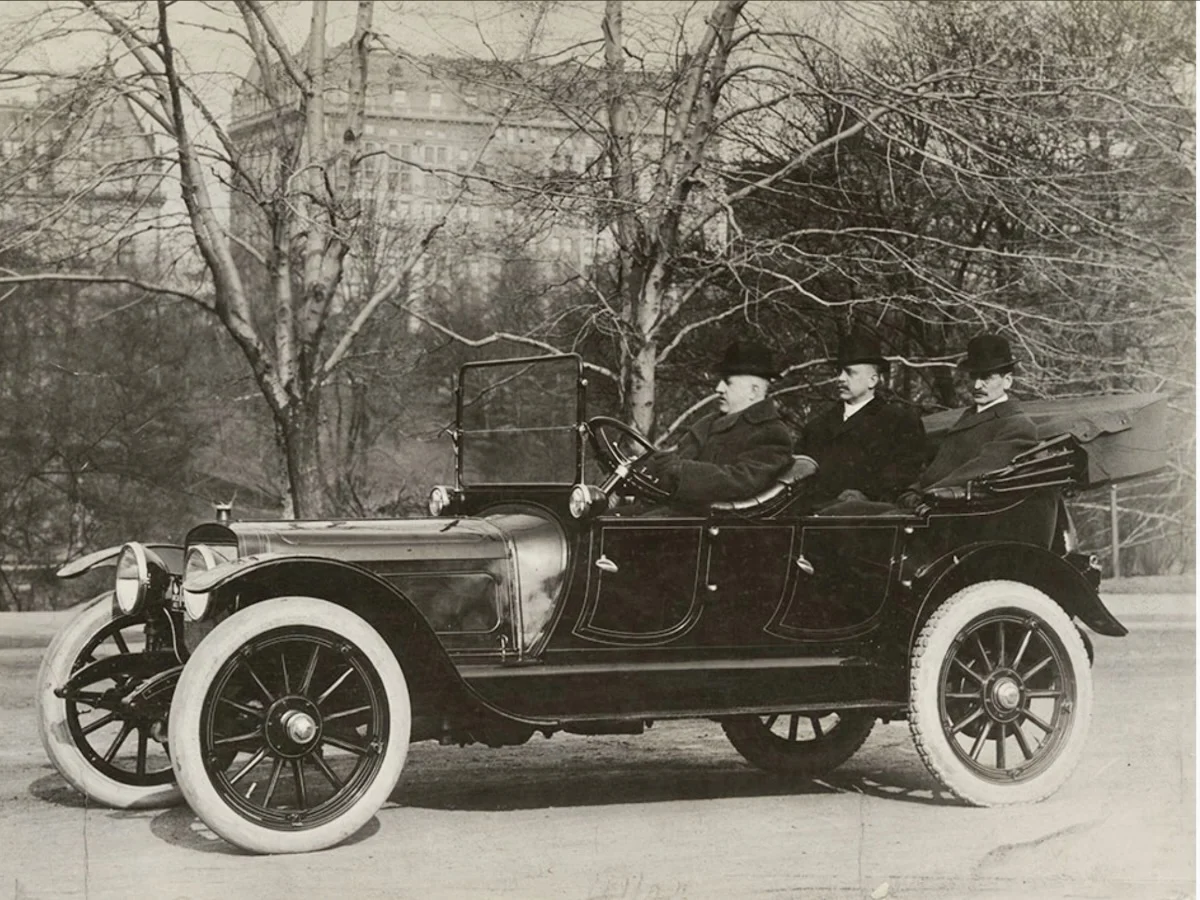
The 1913 Chandler Model 14 with Fredrick C. Chandler at the wheel with Samuel Regar and Charles A Emise in the rear seat.
In 1912, three executives of the Lozier Motor Company— Frederick C. Chandler, Charles A. Emise, and Samuel Regar— resigned from Lozier to establish their own car company to produce a more affordable Light Weight Six automobile that could be purchased by the middle class. They were soon joined by three other Lozier executives (W. S. M. Mead, J. V. Whitbeck, and J. R. Hall) who also saw the future of the automotive industry was in mass-produced automobiles. Together, they established Chandler Motor Cars in Cleveland, OH, in 1913.
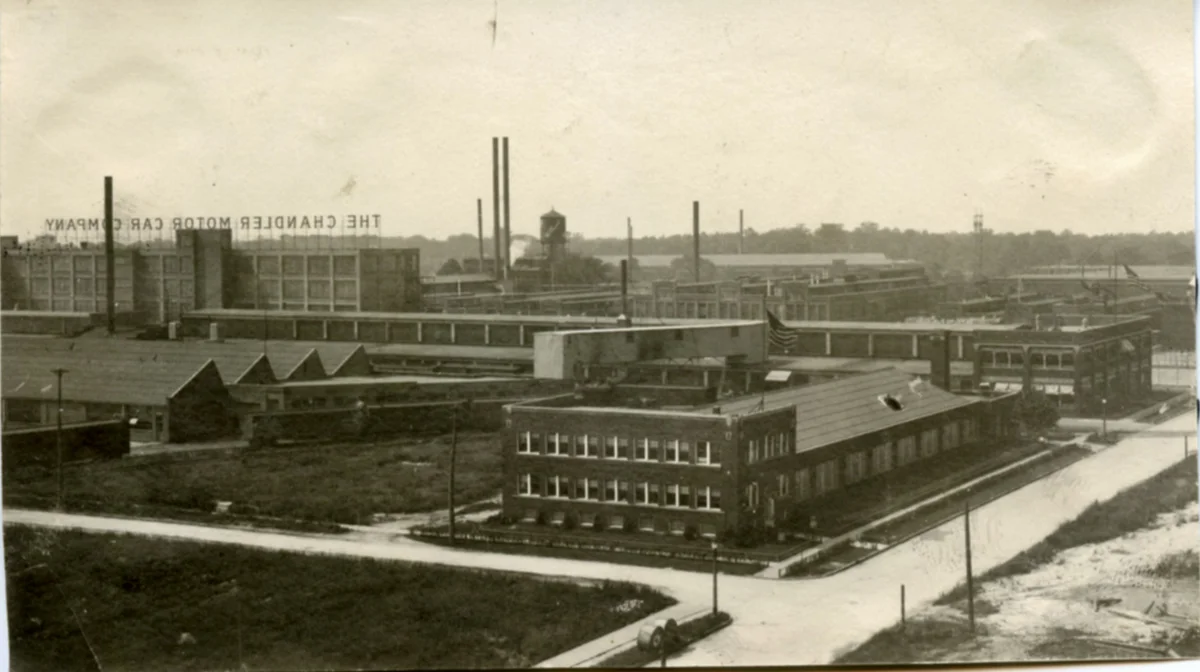
Photograph of the Chandler factory in Cleveland OH in 1913.
The company quickly got to work building a car very similar to one they were already familiar with, the 1913 Lozier Model 77 “Montclair”. Their first automobile was the 1913 Chandler Model 14, a five-passenger touring car with a light-weight six-cylinder producing 35 HP. So similar was the new Chandler to the design of the Lozier that today they most certainly would have faced a barrage of lawsuits for copyright infringement. The new car featured electric start, electric lighting, a pressurized fuel system, and a pressurized oil system, as standard equipment. All this for the low price of $1,785. “Not Only a Six You Can Afford to Buy – but a Six You Can Afford to Run.”
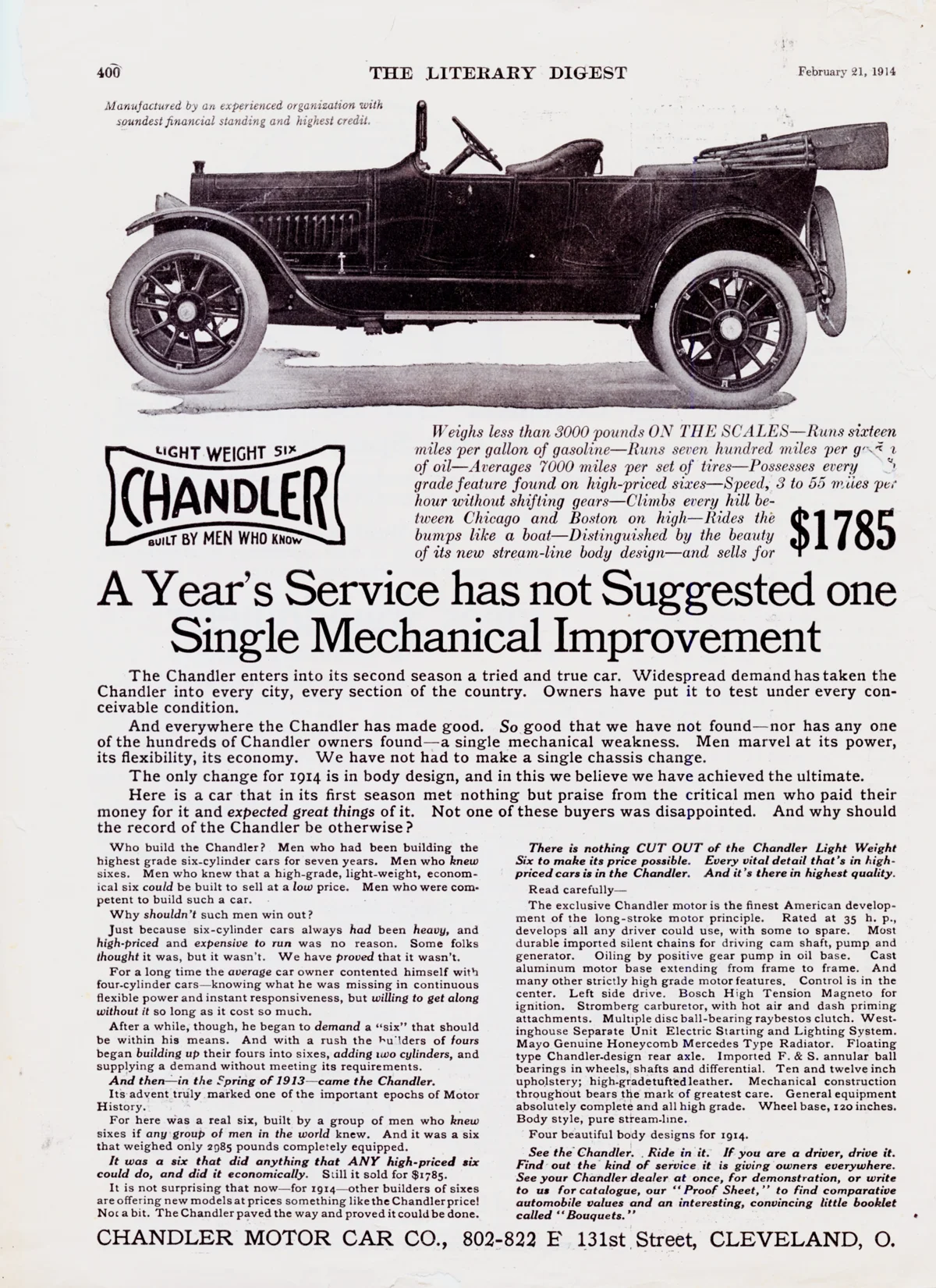
1914 Chandler Model 15
Each year, they evolved the original design, all powered by the “Marvelous Motor” designed and built in-house. Chandler was proud to advertise that they used built and engineered their own cars. At this price point, it was important for them to differentiate themselves from other marques that were using off-the-shelf parts to assemble a car. Enclosed body styles were introduced in limited numbers in 1914 and continued on in greater numbers through the end of production in 1929.
In 1918, like most automobile manufacturers, Chandler contributed to the war effort and built 5 and 10-ton Artillery Tractors for the government. Their contract began towards the end of the war and thus was not fully completed when peacetime once again returned.
1919 brought the introduction of the Cleveland Motor Car, a lower-priced automobile still with a six-cylinder engine included in every car. Chandler now had two lines of cars to market and produce. This line extension proved to be a strain on the company and only lasted until 1926.
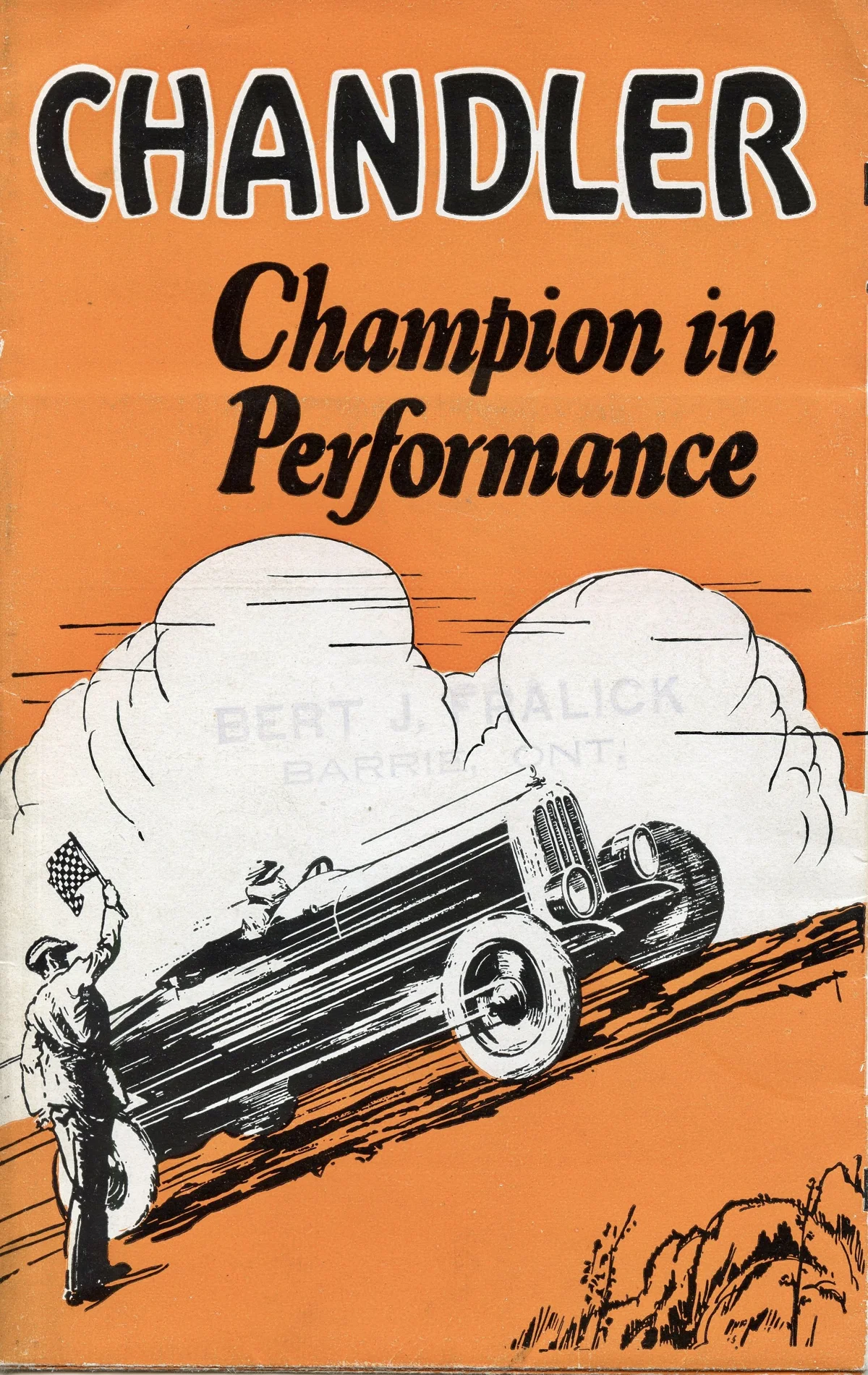
Cover of a 1925 Chandler Dealer Brochure
In 1923, Chandler introduced the “Pikes Peak” motor and “Traffic Transmission” as standard equipment in all cars. The new larger Six proved its mettle racing up the venerable Pike’s Peak roadway under the command of racing driver Ralph Mulford. The new transmission was a constant-mesh gear design aimed at making the act of shifting gears smoother. This led to a popular marketing campaign to encourage more women to drive and helped Chandler increase market share in the industry.
In 1925, the Chandler Motor Car Company changed its name to Chandler-Cleveland Motors Corporation, with plant location at 300 East 131st Street, corner of 131st Street and St. Clair Avenue, Cleveland, Ohio. At this time, the company consolidated the assets of Cleveland Motor Cars into the new company. In 1927, all Cleveland models were sold as Chandler Model 31 Standard Six Series.
The "Production Figure Book" by Jerry Heasley and the "Serial Number Book" by Grace Brigham indicate the Chandler production figures as follows:
1913- 550
1914- 1,950
1915- 1,500
1916- 11,000
1917- 20,000
1918- 30,000
1919- 1 7,200
1920-24,200
1921- 8,800
1922- 11,000
1923- 11,212
1924- 10,207
1925- 10,416
1926- 11,192
1927- 18,445
1928- 15,530
1929- 15,530
These records indicate that Chandler's best production year was in 1918, and the total production from 1913 through 1929 totaled just 210,701 cars produced.
In 1926, an optional all-round lubrication, effected by the push of a plunger, called “one-shot lubrication" was introduced. While popular in advertising and with the public, dealers were “soiled” by the new feature as showroom cars often left their mark on the showroom floor as the enthusiastic public tested this new feature.
1928 brought tremendous change to the company. Chandler introduced to its already full line of little and big six offerings, a new line of small and large in-line eight-cylinder cars with all the luxury amenities that you would expect in a premium model. A new option on all cars was the Westinghouse Vacuum brakes. Chandler was one of the first to offer this innovation that still used rods to actuate all four brakes. It was advertised to triple the effort of your foot in the process. Unfortunately for Chandler, it came at the same time hydraulic brakes became an option for some manufacturers.
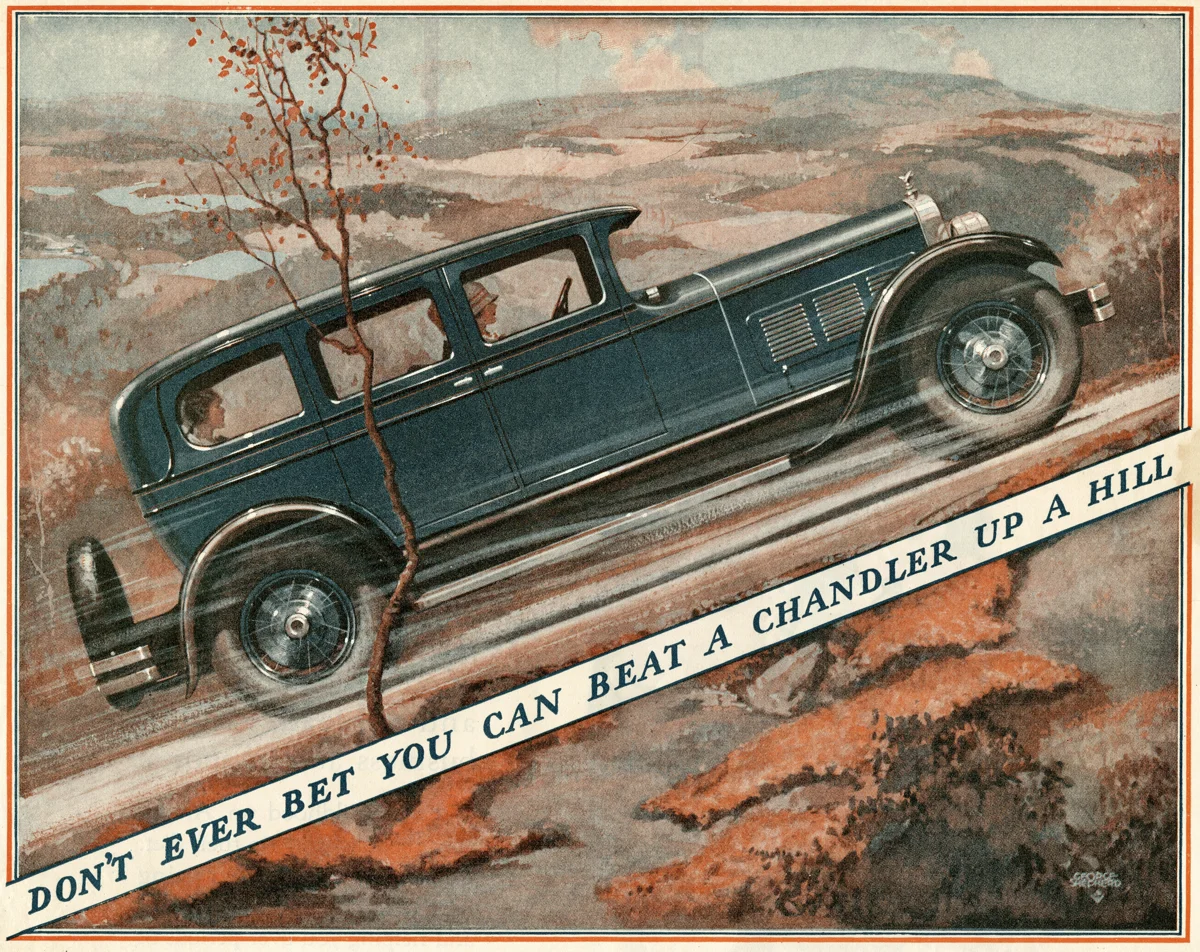
Popular image from 1927 Chandler Advertising
In December 1928, the "HUPMOBILE CORPORATION" purchased the Chandler-Cleveland Motors Corporation at Cleveland, Ohio, and continued the Chandler production until May 1929, when the change was made to produce the Hupmobile automobiles. Hupmobile saw the opportunity to increase production in Chandler’s modern factory and absorb a main competitor in the market. The benefits of this acquisition were short-lived as the stock market crash of 1929 threw the entire world economy into a tailspin. Hupmobile continued production until July 1940.
Chandler cars, though produced in Cleveland, Ohio, USA, were exported all across the globe. With an export market that expanded to parts of Europe, South America, and Australia. Chandler cars have earned a reputation for affordable and innovative motoring.
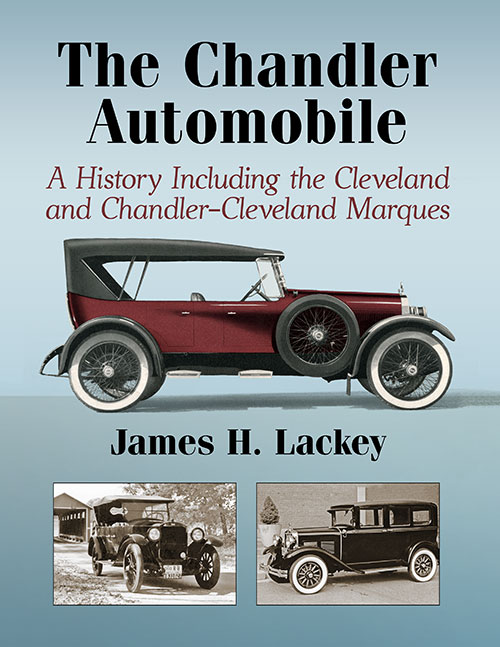
For a complete history of Chandler and Cleveland Motor Cars add to your motoring library the automotive author and historian James Lackey's book The Chandler Automobile.