A Brief History of the Cleveland Motor Car
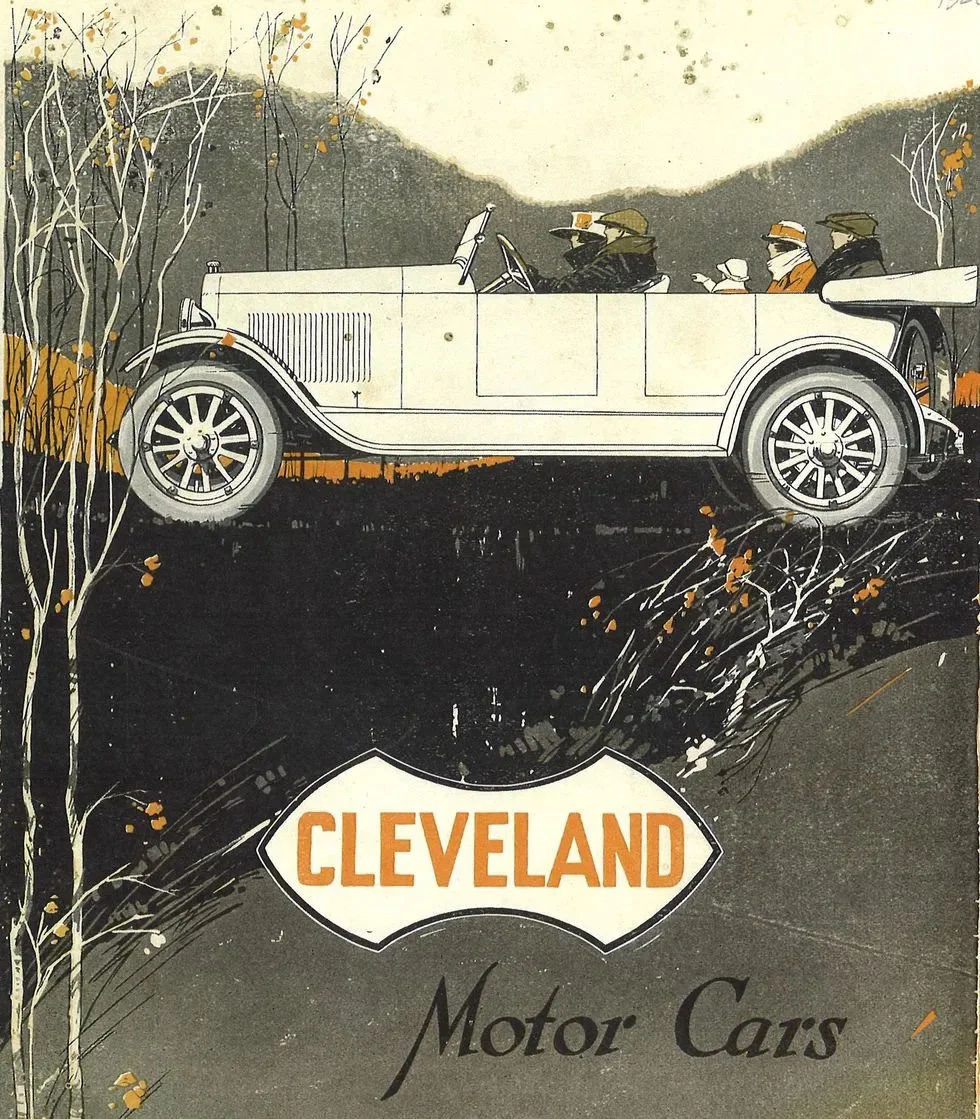
The founders of Chandler Motor Car all came from Lozier, maker of some of the finest and best-engineered automobiles in the United States in the first decades of the 20th century. Their aim in establishing Chandler Motors was to respond to the ever-growing market of mid-priced cars. In 1919, they established Cleveland Motors with this same thought in mind to capture the economy market, but with an in-house-built six-cylinder. In 1919, the company put out the following announcement:
Announcement of the Cleveland Six
Its makers are proud to present to the world the Cleveland Six, a product of engineering skill, devotion to ideals, and a desire to serve. After three years of development in the engineering office and the shop and on the road, the Cleveland Six takes center stage. And it will be in the spotlight just so long as men buy automobiles.
It is not an eleventh-hour idea—the Cleveland Six—and it is not an uncertain quantity. It was ready almost three years ago. Experimental models had then been on the road for a year. Plans for production had been formulated. But our nation was at the brink of war, so the Cleveland waited.
These three years have been productive of much progress in design, and now the Cleveland comes to you a highly perfected car.
In a splendid new plant, the very last word in modern equipment and method, this car is built for a waiting public.
Managing this great plant, directing all its various departments, and guarding every operation, is a group of men whose sincerity of purpose is a guarantee of excellence in their car.
The men producing the Cleveland Six are men of broad and successful experience in the motor car industry. They are men of high standing in the industry, engineers and producers of the first rank. The Cleveland Six—their car—is the exponent of all that is best in six-cylinder car construction. It is an achievement, an individual creation of distinctive merit.
Officers of the Cleveland Automobile Company
J. V. Whitbeck, President
Chief Engineer, Chandler Motor Car Company
Sid Black, Vice-President
Formerly Assistant Sales Manager, Chandler Motor Car Company
J. I. Krall, Secretary-Treasurer
Formerly Assistant Treasurer, Chandler Motor Car Company
F. C. Chandler, Chairman of the Board of Directors
President, Chandler Motor Company
Samuel Regar, Chairman of Finance Committee
Treasurer, Chandler Motor Car Company
Cleveland’s new Model 40, bearing a distinctive peanut-shaped “Cleveland Six” logo, would swiftly earn an award-winning reputation for performance and economy of operation.
While the 1919 Chandler used a 123-inch wheelbase, a 289-cu.in. L-head inline-six, and came in six finished body styles, the Cleveland rode on a 112-inch wheelbase frame and was powered by a 190.8-cu.in. valve-in-head six-cylinder. It was launched as a three-passenger Roadster and five-passenger Touring Car, with four-passenger Coupes and five-passenger Sedans following; the range cost $1,385 to $2,195. While Clevelands were cheaper than the more upscale Chandler cars, they still cost nearly three times as much as a market-leading Ford Model T.
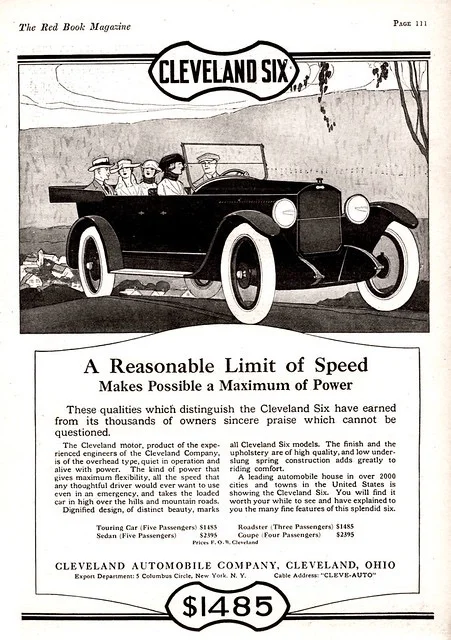
The Cleveland’s in-house-built engine used a three-bearing crank and vacuum-fed Stromberg MB1 carburetor; it made 45 horsepower at 2,200 rpm. That output went to the rear wheels through a multiple-disc clutch and three-speed transmission (similar to Chandler), and ride comfort came from semi-elliptical leaf springs cushioning the movement of the wood-spoke wheels, with external-contracting drums on the rear wheels offering all the Six’s braking force. Cleveland contracted with Fisher to supply bodies, all of which were painted Cleveland Blue, with hoods, fenders, running boards, and wheels factory-finished black.
Production of Cleveland Sixes in 1919 and 1920 amounted to 4,836 cars, with sales reaching up to a high of 12,435 in 1925. Output dropped sharply to 3,213 cars the following year, after which the marque was folded into its parent company. The 1926 Cleveland Model 43 with its 3 1/8” x 4 ¾” motor became the 1927 Chandler Model 43 Special Six to complement the new Royal Eight, Big Six, and the Standard Six Series with a motor of 3” x 4 ¼”. The Company certainly had the whole market covered; unfortunately, the market was very competitive during the Roaring 20’s, and Chandler was struggling to maintain its dealers. With the consolidation of Cleveland into Chandler, the company ran up losses of nearly half a million dollars. Yet the ever fiscally responsible company nearly broke even in 1928, the year that competitor Hupmobile bought the company.
Today, there are very few Cleveland Motor Cars surviving, maybe a dozen or more. The nature of their economy status and the scrap drive of WW II no doubt weighed heavily on their survival rate. We are fortunate that there are caretakers today and a public that appreciates these cars and keeps them for future generations.
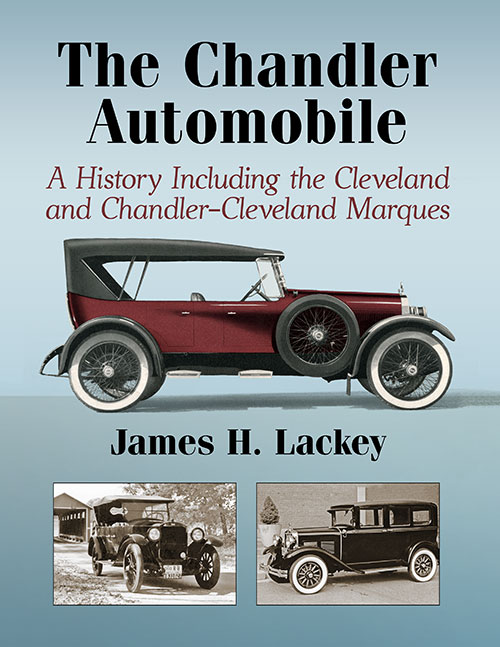
For a complete history of Chandler and Cleveland Motor Cars add to your motoring library the automotive author and historian James Lackey's book The Chandler Automobile.